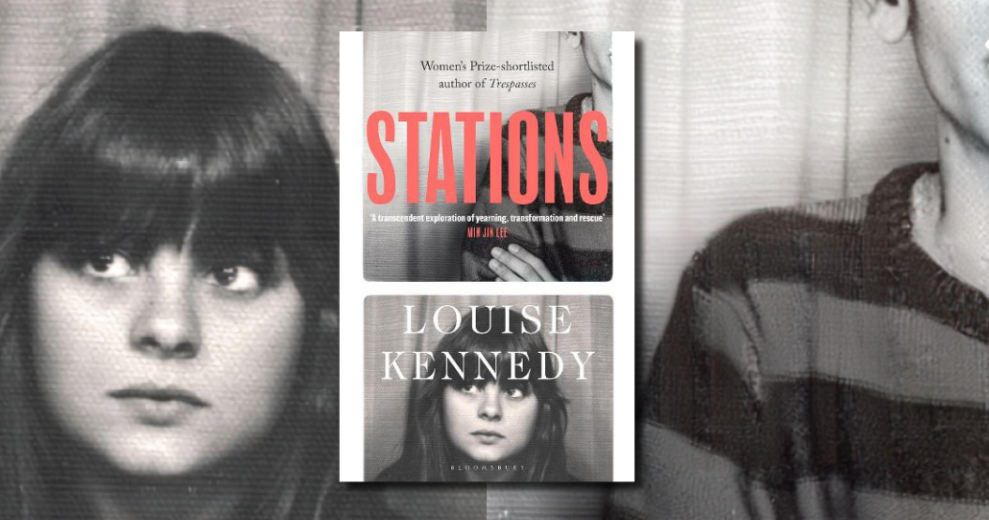
A Q&A with Louise Kennedy, prize-winning, Sunday Times bestselling author of Trespasses.
Stations opens in the early ‘80s and spans a period of 25 years. Why did you choose to situate the novel in this period of time?
Like Róisín, I turned fifteen in a drab town in the Irish midlands in 1982. It was a strange time in Ireland, tumultuous yet stagnant. The previous year, ten men had died on hunger strike in the north and forty-eight young people had perished in a fire at a St Valentine’s day disco in Dublin because the exits were locked. The economy was in a deep recession and emigration levels had risen to their highest since the fifties. Also, like Róisín, my family had left the north of Ireland a couple of years earlier, which has had the effect of placing my teenage years in stark relief against my childhood. The minutiae of that time are almost luridly vivid to me. The haircuts that went wrong and the burgundy-coloured over-the knee socks; the menthol cigarettes and classrooms that smelled of Taytos and menstrual blood. Stations follows Róisín and Red to London and by the end of the decade they are being pulled in very different directions: Róisín craving stability and Red spiralling into chaos. The story jumps forward to 2007. It is the end of the ‘Celtic Tiger’ era. The frugality and hopelessness the characters grew up with has been replaced by reckless consumerism and a brash sort of confidence and I find that contrast fascinating. 2007 is also the year Róisín turns forty. I wanted to know what, if anything she has learned about herself and those close to her. Is she happy? Does she carry regret? Has she learned to forgive?
The novel begins in and circles back to a small Irish town, exploring the urge to leave and the pull to return. What do you think it suggests about the push and pull of community?
I think maybe I am interested in community because I am always the outsider. When I was twelve, my family moved from the north to the south of Ireland for various reasons to do with the Troubles – not least a couple of bomb attacks on my grandmother’s pub and the sectarian intimidation my father experienced at work. My parents assured me the relocation would make our lives perfect but I struggled. Making friends was a treacherous business and by the end of my schooldays I was virtually ostracised, a fate I inflicted on Róisín. Late in Stations, she reflects on that time: ‘I’d made friends as a child, but we moved and I couldn’t find my place. Or maybe I didn’t know my place.’ Yet teenage Róisín persists, going to the dreaded discos, running errands for Tina, her tormentor, desperate to belong. But their generation is leaving in droves, and not only to find work: Red is run out of town, Barry is fleeing his father’s expectations, Róisín feels rejected by her mother. By the end of the eighties, Róisín thinks she has left her family and the town behind her, yet the life she makes in London ultimately does not fulfil her. It is not until the end of the book that she feels something close to the pull of home. All the characters are drawn back there, in one way or another.
Nick Hornby has said of Stations ‘at its centre is a brilliantly drawn collection of found family’. Is this how you’d describe your novel?
I love that Nick said that. I think that for people who are far from home, and particularly for those who feel like we don’t belong at home, other relationships are very important. With her family disintegrating, Róisín invests all her hope in Red, unable to understand that he can’t return her love. Yet in other ways he gives her so much. Through his eyes, she sees the humanity in men like Micksy. Red insists that she reconcile with her father and though that relationship is fraught, she gains a sister and a step-mother, ‘the best person in her life’. She learns to trust Guy and maintain a friendship with Sinéad. For all that, it isn’t until the end of the book that it dawns on Róisín that she is not alone.